
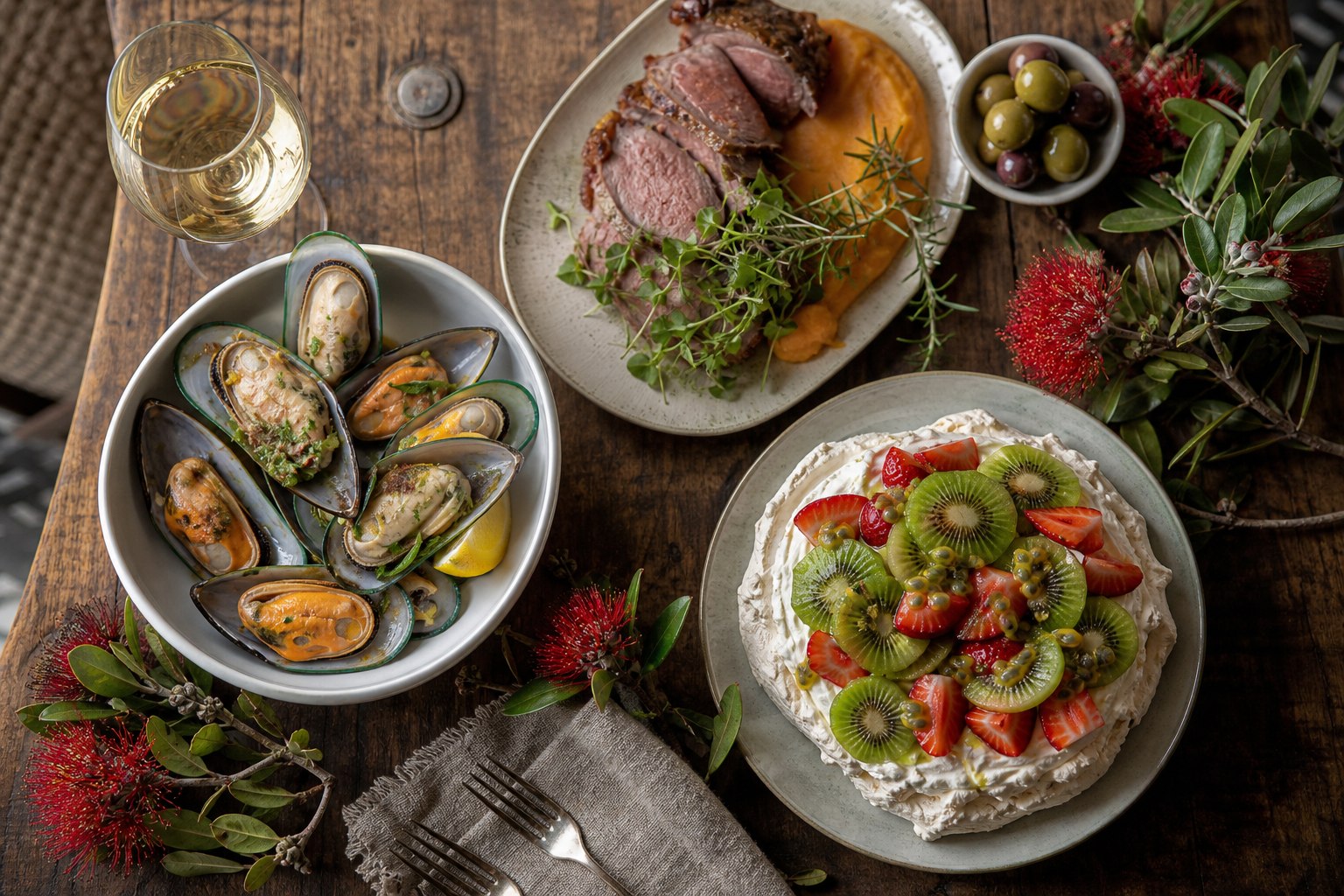
New Zealand cuisine often gets overlooked because it does not announce itself loudly. There is no single signature dish that travels the world the way pizza or pad thai do. What the country has instead is exceptional produce, three layers of food culture (Maori, Pacific, and Pakeha) sitting on top of each other, and a generation of chefs who have spent the last decade quietly building a confident national style. For visiting food lovers, that means a string of memorable meals if you know where to look.
Start With the Land and Sea
New Zealand sits on rich farmland and is surrounded by clean cold ocean. Lamb is justly famous, but the country also produces excellent beef, venison, free-range pork, and a growing range of artisan cheeses. The seafood is even better. Green-lipped mussels grow only here and in a small part of South America. Bluff oysters from the cold Foveaux Strait are the equal of any in the world. Crayfish, snapper, kingfish, paua (abalone), and the small whitebait that locals turn into delicate fritters all show up on serious menus.
Dishes You Should Try
Hangi
A hangi is a traditional Maori method of cooking meat and root vegetables in a pit lined with hot stones. Lamb, chicken, kumara, pumpkin, and cabbage are wrapped, lowered into the pit, and slow-steamed for several hours. The flavour – earthy, smoky, and tender – is unlike anything you have eaten before. Tourist-oriented hangi are common in Rotorua, but the most memorable versions are still served at a marae or a family gathering.
Pavlova
Australia and New Zealand will argue about pavlova until the end of time. The Kiwi version has a crisp meringue shell, a soft marshmallow centre, and a generous heap of whipped cream topped with kiwifruit, strawberries, and passionfruit. Every grandparent makes the best one in the country.
Whitebait Fritters
Whitebait are the tiny translucent young of native fish, scooped in nets from West Coast rivers each spring. They are folded into a simple egg batter, fried in butter, and served on white bread with lemon. It is one of the country’s true seasonal treats, expensive even by local standards, and worth every cent.
Hokey Pokey Ice Cream
Vanilla ice cream studded with crunchy honeycomb toffee. Nearly every dairy and supermarket sells it. Try the version from Tip Top or, better still, a scoop from one of the small artisan parlours that have sprung up over the past decade.
Meat Pies
The humble meat pie is the country’s true national dish. Steak and cheese, mince and gravy, butter chicken, and bacon and egg are the staples. Stop at any small-town bakery and ask what they are known for. The annual Bakels Pie Awards drive bakers to obsessive standards.
Coffee, Wine, and Craft Beer
The flat white was either invented in Auckland or in Sydney, depending on who you ask, and either way the country takes it seriously. Even modest cafes pull excellent espresso. Coffee culture is so well embedded that the worst coffee in a small New Zealand town is usually better than the best in many cities elsewhere.
Wine deserves its own deep dive, and we covered the country’s main regions in our guide to vacations in New Zealand. The short version: Marlborough Sauvignon Blanc, Central Otago Pinot Noir, and Hawke’s Bay Syrah are world-class. Craft beer has exploded too, with breweries like Garage Project in Wellington, 8 Wired in Warkworth, and Emerson’s in Dunedin leading the way.
Markets, Cafés, and Restaurants Worth Planning Around
- La Cigale French Market in Auckland on Saturday mornings – oysters, terrines, and fresh bread from local producers.
- Wellington’s Cuba Street and surrounds – the densest concentration of independent restaurants in the country, from Filipino to modern Maori.
- Christchurch Farmers’ Market at Riccarton House – the country’s first true farmers’ market and still one of its best.
- Amisfield in Central Otago for a long lunch built around a five-course menu and outstanding Pinot Noir.
- Cazador in Auckland for game and offal handled with skill and a sense of humour.
- Hiakai in Wellington, where chef Monique Fiso has built a tasting menu around indigenous Maori ingredients.
Eating Like a Local
Breakfast is a serious meal here, and weekends tend to start with brunch at the café down the road. Lunch is often light: a pie, a sandwich, a slab of frittata. Dinner is the social meal, and Kiwis are generous about inviting visitors home if you have made any kind of connection during your trip. Bringing a bottle of decent wine is the standard offering.
Tipping is not expected. Service charges are not added. If a meal was truly outstanding, leaving ten per cent is a kind gesture, but you will never be made to feel that you should.
By the end of a trip you will have your own list of favourite bakeries, the café with the best long black, and a hangi memory that will keep you trying to recreate the smoke at home. If you are still planning where to base yourself, take a look at our notes on the luxurious hotels of New Zealand – several of them have restaurants worth a detour in their own right.